During Covid19 Libraries West are giving free access to the library edition of Ancestry to members at home, (previously only available at the library).
If you have a Dorset Libraries card you first need to log in to your Libraries West account. You will see this screen:
If anyone finds any other free information please let us know here.
TNA are providing free downloads of some of their digitised documents. These are mostly probates of wills. These were previously £3.50.
Go to their website to find out more. The downloads are pdf.
We have taken advantage of this to download all the wills concerning people from Milton Abbas. We found about 30 that we had not downloaded previously. These are currently being transcribed. They date from 1638 to 1851.
We would welcome any help in transcribing these – something to do during lockdown!
Other documents are available, particularly Admiralty records.
List of wills downloaded from TNA:
Will of The Honorable Henry Dawson Damer of Milton Abbey
31 Aug 1841
Will of Mary Jarvis
18 Feb 1784
Will of John Gover, Mariner of Milton Abbey, Dorset
3 Jan 1709
Will of Elijah Leach, late Servant of Milton Abbey , Dorset
26 Jan 1837
Will of John Butler, Yeoman of Milton Abbey, Dorset
20 Feb 1666
Frederick Cross . Age: 19 years 2 months. Place of birth: Milton Abbey
Will of Robert Welsted of Milton Tregonwell, Dorset
9 Apr 1567
Will of Joseph Damer of Roscrea , Tipperary
11 Feb 1743
Reginald John Sprules, b 5 Feb 1905, Milton Abbas
Certificate for House of Margery Pooke set aside for Dissenting Protestants
15 Jul 1707
Seal of John Bradley, Abbot of Milton
1530
Petitioners: Abbot and convent of Milton. Addressees: King
1347
Will of Ann Bridge, Widow of Abby Milton, Dorset
23 May 1825
Will of Elizabeth Squib or Squibe, Widow of Middleton, Dorset
16 Jun 1604
Will of Richard Squybbe, Yeoman of Middleton, Dorset
8 Oct 1580
Will of Jane George, Spinster of Abbey Milton
13 Dec 1853
Will of James Dyer, Plumber, of Abbey Milton
8 Apr 1824
Will of Benjamin Smart, Barber of MA Dorset
12 May 1806
Will of Andrewe Lanckford, Yeoman of Milton Abbas, Dorset
5 Sep 1639
Will of Symon Alner, Weaver of Milton Abbas, Dorset
20 Nov 1640
Sentence of Samuel Adams of Milton Abbas , Dorset
30 June 1748
Will of William Wood, Tailor of Milton Abbas , Dorset
20 May 1763
Will of Henry Jeanes, Collar Maker of Milton Abbas, Dorset
14 July 1641
Will of Sarah Elford, Spinster of Milton Abbas , Dorset
20 Aug 1851
Will of Letitia Spinney, Widow of Milton Abbas , Dorset
15 Jun 1848
Will of Mary Woodard, Widow of Milton Abbas , Dorset
3 Aug 1840
Will of William Kiddle of Milton Abbas , Dorset
25 May 1835
Will of Samuel Adams, Yeoman of Milton Abbas, Dorset
14 Jul 1748
Will of Henry Shepheard, Husbandman of Milton Abbas, Dorset
18 Oct 1638
Sentence of Francis Sheparde or Sheppard of Milton Abbas, Dorset
19 Feb 1591
Will of John Almond, Tailor of Milton Abbas, Dorset
3 Sep 1639
Will of John Shepheard or Shephard, Husbandman of Milton Abbas, Dorset
17 Sep 1640
Will of John Sheaperd or Sheperd, Baker of Milton Abbas, Dorset
There are four books in all which cover the period 1771 – 1836. No others exist.
One of our transcribers has single handedly just completed the transcription of all 229 pages of the third book in this series which covers the years 1818 to 1836 and we now have a spreadsheet containing 18291 rows of records.
We have now completed the transcription of all four books producing about 60000 records – a fantastic achievement.
A huge thank you to all our transcribers who have spent hundreds of hours working on this.
A great resource for local and family historians. A great legacy for our group.
The Milton Abbey Priory Archive is a roll of parchment in the Dorset History Centre which contains twenty separate documents all written in Medieval Latin. The first document is the Metes and Bounds of Milton Abbas with Woolland, dated 1384/5. This was translated by Peter Traskey and is given as Appendix XII, in his book ‘Milton Abbey: A Dorset Monastery in the Middle Ages’, 1978.
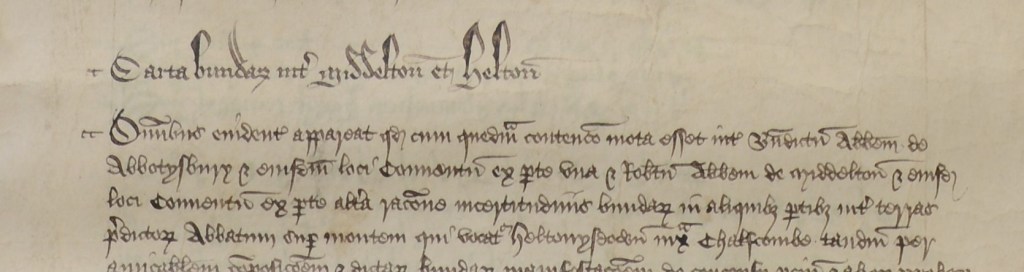
The second document in the roll is a charter of the bounds between Milton Abbas and Hilton, dated 1319. This arose over a dispute between the Abbot of Milton and the Abbot of Abbotsbury (who held Hilton at the time). It begins:
CARTA BUNDARUM INTER MIDDELTON ET HELTON
Omnibus evident appareat quod cum quedam contencio mota esset inter Benedictum [de Loders, 1297-1320] Abbatem de…
Although our meetings and exhibition have been postponed, monthly updates will continue to be emailed to members, and research is continuing as follows:
Ham family of Milton Abbas research – all wills and other documents have been transcribed and searched. Writing up is in progress.
18th century Clothing and dress – research in progress ready for exhibition.
Milton Abbas Grammar School – research complete, writing up for exhibition.
Milton Abbas Occupations – research in progress.
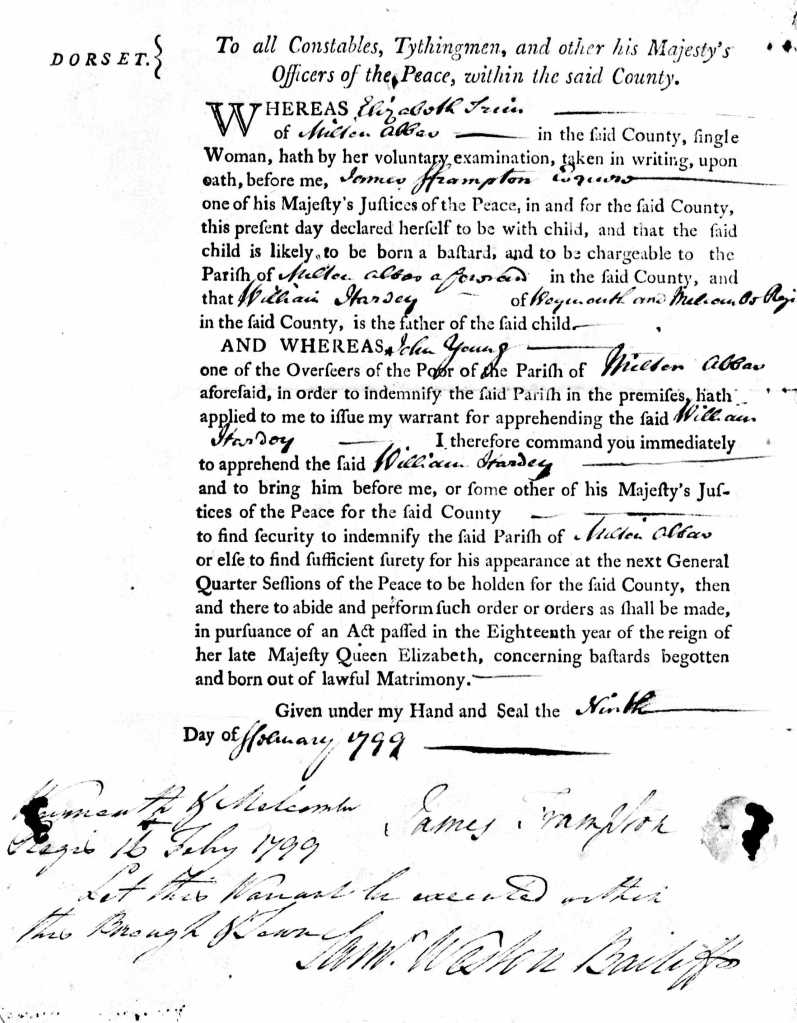
Milton Abbas Martyrs – six men given 2 months hard labour for “Combining with others to increase wages” in 1803 – thirty years before the Tolpuddle Martyrs, completed but we would like more information on the Dorset Justice “James Frampton”
Vermin – Churchwardens Accounts transcribed and searched.
St James Church, Milton Abbas, consecrated 1786, research ongoing.
Milton Abbas First School – we now have a comprehensive diary of the years 1985 – 1991. Now available for future local and family historians to research.
Overseers of the Poor Account books – transcription almost complete of all existing records 1771 – 1836. That is 60 000 records! Thanks to our wonderful transcribers. These records are in spreadsheets and available for searching and research.
The ‘Lloyd George Domesday Survey’ of 1911 is being transcribed.
Hoare’s Bank Archives have been visited and initial search for Damer family accounts of the 18th and 19th centuries has been done.
We have purchased new display boards for our exhibitions thanks to a local grant.
After this date there are no more payments by the Overseers of the Poor of Milton Abbas. Poor people then had to use the Workhouse which had been set up in Blandford Forum – one of the much feared ‘Union Workhouses’, which had been brought about by an Act of Parliament.
A huge thanks to the single handed effort of our transcriber from Canada. The sigh of relief on completing the transcription of 8611 records into a spreadsheet, was audible from across the Atlantic Ocean. He is now taking a very well earned break.
Our members can now search for the names of people in Milton Abbas, whether they were Overseers, Justices, Poor Rate payers, paupers, or the occasionally ill or out of work.
A magnificent achievement, and a legacy of the Milton Abbas Local History Group for future generations of researchers and family historians.
On 23-25 May 2020, Milton Abbas Local History Group will be holding a free entry exhibition in St James Church and the Reading Rooms, Milton Abbas, featuring village life before the 20th century. We are looking for any objects or documents that may be of interest and that you are willing to lend or share with us.
We are looking for anything that might be of historical interest, that we could show to visitors. These could feature any crafts or trades of the times gone by, e.g. old woodworking, smithing, plumbing, shoemaking tools, Dorset buttons, gloves, lace, etc. Or village school related items. It might be something that has been dug up from your garden or found in your attic, ploughed up in a field, metal detected, or old letters and documents. You may have even researched a local family. Even fragments of old pottery can be interesting. We already have a spinning wheel, a floorboard with writing on the back, wig curlers, quill and inkpot, kindling, and brewery items.
If you have anything that you think might fit the bill and you are willing to lend, or allow us to photograph, please Contact us.
And please put the 23-25 May 2020 in your diary. We look forward to meeting you at the Milton Abbas Local History Group Exhibition.
We are just transcribing some bills, vouchers or receipts for Milton Abbey Estate for labouring work. These are answering some questions such as the names of the labourers and how much they were paid, but raising more – the list contains many names that are not paid? Why are there different rates of pay, mostly, but not always, 1s per day? Others getting 8d, 6d or 4d a day – perhaps children, but what were they doing to assist in digging and wheeling? What and where were they digging? The work done is measured by the yard – presumably a cubic yard of soil – but how far was it carried by wheelbarrow?
There are women’s names listed as well. Were they digging and wheeling too?
This is a very interesting set of bills. It is a complete record of a major project of work from November 1774 to May 1775, involving as many as sixty people a month over the seven months. A dozen or more of these are workmen being paid by the day, the rest are men and some women being paid according to how many cubic yards of earth or other material they have moved. There are also bills for two blacksmiths and a saddler and harness maker for the production/repair of wheelbarrows, pickaxes, shovels etc., and for horse harness, demonstrating that horse-drawn carts and barrows were also used in the excavations. The work might have been landscaping for the new park, work on the mansion house or abbey church, demolishing the Old Town or preparing the site of the new village, or perhaps all four. Capability Brown delivered his plans for the new village in November 1774, so the work may be in direct response to that. The final bills refer to the building of a stone wall and the construction of a drain from the “west front” to the common “shore” (or sewer). This could possibly refer to the west front of the mansion house or the abbey church. Sam Watson, who was in charge of the project, also appears as a witness on the first lease in the new village and served as Lord Milton’s nomination as Overseer of the Poor in the first few years of the new village. The amount of earth or other materials moved during the work rivals that of other of Capability Brown’s major works at Petworth and Stowe. There is a question of whether the project was saving the parish on payments to the poor through the winter by putting them to work on the project. Although this is the only set of bills that remain, it may be that similar projects took up some of the winter months for the nearly thirty years it took to complete Lord Milton’s park.
As well as the common Milton Abbas names – Fiander, Vacher, Arnold, Foot, Rogers, etc, there are labourers names which do not otherwise occur in Milton Abbas records – Stokes, Symes, Storrage, Swanger, Burnet, Duke. Where did they come from?
As usual there are more questions than answers.
Samuel Watson was the foreman and was paid one guinea a week. Note that the labourers were working 6 days a week. This continued into the winter months and must have been a vital source of income for agricultural labourers.
We are a Local History Group and we undertake research into the old village, the Street and the lives of those that loved and worked there. We appreciate any help that members can provide to that end.
Family historians, please note that we do not focus on Family history’s but if you feel you could help and contribute to the social history of Milton Abbas Please get in touch.