On 23-25 May 2020, Milton Abbas Local History Group will be holding a free entry exhibition in St James Church and the Reading Rooms, Milton Abbas, featuring village life before the 20th century. We are looking for any objects or documents that may be of interest and that you are willing to lend or share with us.
We are looking for anything that might be of historical interest, that we could show to visitors. These could feature any crafts or trades of the times gone by, e.g. old woodworking, smithing, plumbing, shoemaking tools, Dorset buttons, gloves, lace, etc. Or village school related items. It might be something that has been dug up from your garden or found in your attic, ploughed up in a field, metal detected, or old letters and documents. You may have even researched a local family. Even fragments of old pottery can be interesting. We already have a spinning wheel, a floorboard with writing on the back, wig curlers, quill and inkpot, kindling, and brewery items.
If you have anything that you think might fit the bill and you are willing to lend, or allow us to photograph, please Contact us.
And please put the 23-25 May 2020 in your diary. We look forward to meeting you at the Milton Abbas Local History Group Exhibition.
We are just transcribing some bills, vouchers or receipts for Milton Abbey Estate for labouring work. These are answering some questions such as the names of the labourers and how much they were paid, but raising more – the list contains many names that are not paid? Why are there different rates of pay, mostly, but not always, 1s per day? Others getting 8d, 6d or 4d a day – perhaps children, but what were they doing to assist in digging and wheeling? What and where were they digging? The work done is measured by the yard – presumably a cubic yard of soil – but how far was it carried by wheelbarrow?
There are women’s names listed as well. Were they digging and wheeling too?
This is a very interesting set of bills. It is a complete record of a major project of work from November 1774 to May 1775, involving as many as sixty people a month over the seven months. A dozen or more of these are workmen being paid by the day, the rest are men and some women being paid according to how many cubic yards of earth or other material they have moved. There are also bills for two blacksmiths and a saddler and harness maker for the production/repair of wheelbarrows, pickaxes, shovels etc., and for horse harness, demonstrating that horse-drawn carts and barrows were also used in the excavations. The work might have been landscaping for the new park, work on the mansion house or abbey church, demolishing the Old Town or preparing the site of the new village, or perhaps all four. Capability Brown delivered his plans for the new village in November 1774, so the work may be in direct response to that. The final bills refer to the building of a stone wall and the construction of a drain from the “west front” to the common “shore” (or sewer). This could possibly refer to the west front of the mansion house or the abbey church. Sam Watson, who was in charge of the project, also appears as a witness on the first lease in the new village and served as Lord Milton’s nomination as Overseer of the Poor in the first few years of the new village. The amount of earth or other materials moved during the work rivals that of other of Capability Brown’s major works at Petworth and Stowe. There is a question of whether the project was saving the parish on payments to the poor through the winter by putting them to work on the project. Although this is the only set of bills that remain, it may be that similar projects took up some of the winter months for the nearly thirty years it took to complete Lord Milton’s park.
As well as the common Milton Abbas names – Fiander, Vacher, Arnold, Foot, Rogers, etc, there are labourers names which do not otherwise occur in Milton Abbas records – Stokes, Symes, Storrage, Swanger, Burnet, Duke. Where did they come from?
As usual there are more questions than answers.
Samuel Watson was the foreman and was paid one guinea a week. Note that the labourers were working 6 days a week. This continued into the winter months and must have been a vital source of income for agricultural labourers.
The archives at Winchester College are very important for the history of Milton Abbey prior to the surrender in 1539.
We were fortunate to contact the archivist who gave us access to photograph some of the key documents in this fabulous resource. These are Court Rolls, Account Rolls and grants of leases by the Abbey, and all in superb condition.
We have found only one reference in the literature to these documents: ‘Milton Abbey: A Dorset Monastery in the Middle Ages’, Peter Traskey, 1978.
How the documents came to be in the possession of Winchester College is another story in itself.
We took high resolution images of 170 of the documents, and there are plenty more to do!
We need to transcribe these before we can understand the significance to the study of the Dissolution of the Monasteries in general, and Milton Abbey in particular. The grants of leases are an example of the general phenomenon in the years just before the surrender for monasteries to obtain cash. This cash was used as ‘inducements’ – a euphemism for bribes, to Thomas Cromwell, his commissioners, and the local aristocracy, in the hope that they would support the monasteries.
There are documents of the grants of leases in the Letters and Papers of Henry VIII held at The National Archives (SP/2).
We believe that this information would contribute significantly to a PhD on this particular aspect of the Dissolution of the Monasteries.
Please Contact Us if you are interested, or for more information.
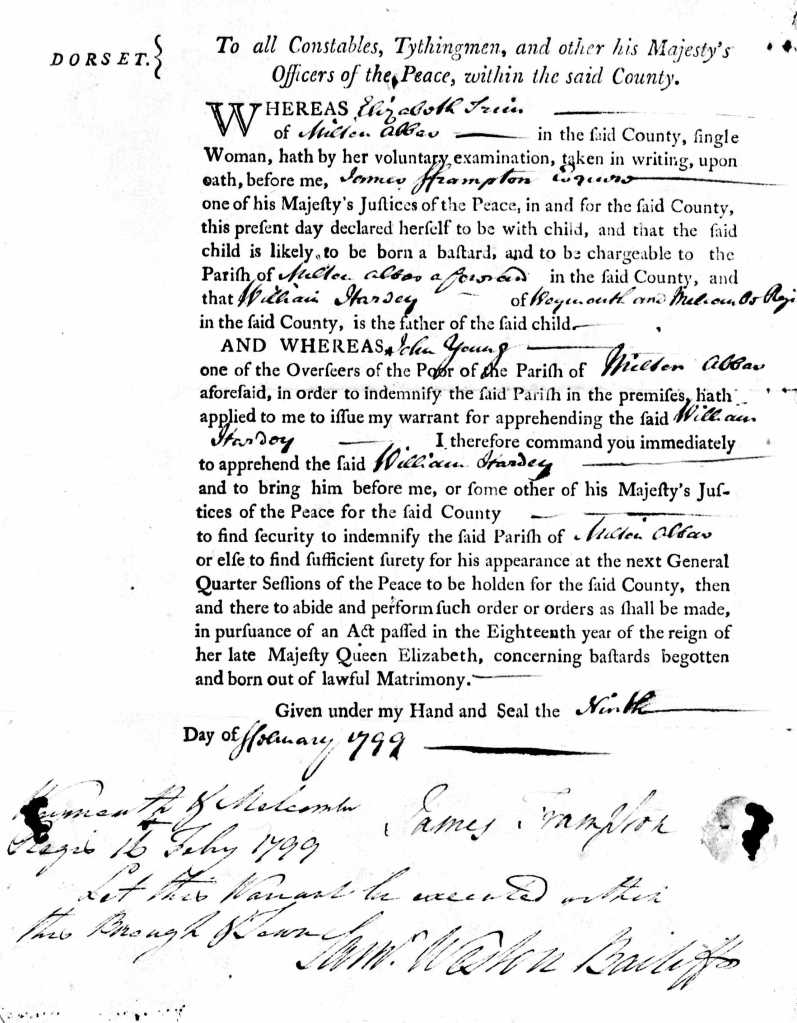
We have just been given the original of this document. It is now transcribed and available for members to share. Her name is spelled Charlotte Vatcher in the document, and Charlotte Vacher on the reverse. John Sturmy is named as the father of the male bastard child.
The child was baptised in Milton Abbas in July 1829 and named as Stephen Vacher.
From an analysis of the names occurring in the Churchwarden’s Accounts 1750 – 1752, it seems clear that it was mostly children and a couple of housemaids who were being paid for catching vermin. These came from many of the households in the Old Town of Milton Abbas, and there are 80 different people paid in just these two years. The payments did not just go to the farmers and their children but to most families. The same family names also occur as paying church rates.
We will examine the Churchwarden’s Accounts further to discover if this remained true after the building of the new village.
This excellent book uses pre-Reformation Churchwardens Accounts to show what life was like for the people of the parish, including rural parishes in the 14th, 15th and early 16th centuries. How the parish worked as a community, including of course all the religious ceremonies, plays, processions, holy days, dressing the church, candles.
We are now working on transcribing Book 3 which covers the years 1818 – 1830. The way of accounting has changed from previous books – here the entries still include about 20 people being paid monthly on out relief, but there are many more bills being paid to tradesmen. The names of the tradespeople are given, but the goods and services are not identified. The “disbursements” are no longer named as such, they are included in the monthly payments. These were additional payments to those in need.
Although there are people on out relief, there was probably a poor house as well, and the bills are probably for supplies to this.
This 5 second video clip occurred in the middle of the BBC Countryfile program broadcast 1 Sep 2019. It had nothing whatsoever to do with the rest of the program which concerned evacuees of Word War 2.
We would love to know where the rest of the film might be, and what it was about. We will ask the BBC, but any information would be most welcome.
We are a Local History Group and we undertake research into the old village, the Street and the lives of those that loved and worked there. We appreciate any help that members can provide to that end.
Family historians, please note that we do not focus on Family history’s but if you feel you could help and contribute to the social history of Milton Abbas Please get in touch.