We are now working on transcribing Book 3 which covers the years 1818 – 1830. The way of accounting has changed from previous books – here the entries still include about 20 people being paid monthly on out relief, but there are many more bills being paid to tradesmen. The names of the tradespeople are given, but the goods and services are not identified. The “disbursements” are no longer named as such, they are included in the monthly payments. These were additional payments to those in need.
Although there are people on out relief, there was probably a poor house as well, and the bills are probably for supplies to this.
This 5 second video clip occurred in the middle of the BBC Countryfile program broadcast 1 Sep 2019. It had nothing whatsoever to do with the rest of the program which concerned evacuees of Word War 2.
We would love to know where the rest of the film might be, and what it was about. We will ask the BBC, but any information would be most welcome.
This is the longest, oldest, and certainly the most tedious will that we have ever transcribed.
One of our transcribers has single-handedly completed the mammoth task of transcribing the 19 pages of tightly spaced, 16th century legal writing. We owe them a huge debt of gratitude for this.
Although it is in English, the letters are not consistently formed, the spelling is such that Google docs spell checker has had a headache, and the sheer repetition of phrases is mind boggling.
This is an example chosen at random. Our transcription is : “the said John Tregonwell myne heire apparent to decease and die w[i]t[h]out heires of his bodie lawfully begotten, that then my said mannor of Estpullam [East Pulham] and all other my lands and tenements in Estpullam aforesaid w[i]th there appurtenances shall holie [wholly] remaine to theires [the heirs] males of the bodie of the said Jane Thornehill my Daughter and to theires males theire bodies lawfullie begotten, the remaynder thereof for lacke of suche yssue to the right heires of me the said Sir John Tregonwell Knight for ever, now my will mynd and intente is that yf the said Robart Thornhill Esquire do not”
The fluidity of spelling is amazing. Although this was written by a professional scribe at the Prerogative Court of Canterbury, he can spell the exact same word in two different ways in the same sentence!
The transcribed document gives us entirely new information not found elsewhere. It includes the friends and relatives of Sir John Tregonwell, a room by room inventory, and the manors and estates in Dorset that were purchased between his purchase of the former Abbey of Milton from Henry VIII in 1540 and the date of this will of 1563.
These documents are of vital importance for the history of people who lived in Milton Abbas.
Not only do they give us family relations: brothers, sisters, sons, daughters, nephews, nieces and cousins but also what people possessed in the way of ‘goods and chattels’.
So far we have transcribed 70, and we are about half way through. So there are plenty of opportunities for more volunteers.
It would be really useful if we knew some Latin. Many of the older wills have their probate grant, a final paragraph in Latin, which was probably of a standard formula.
It was a sizzler in every meaning of the word! With clear blue skies and thousands of visitors, The Street Fair was busy all day long.
We had over 1000 visitors to our exhibition which was tucked away in the south aisle of St James Church. There was a continuous stream of visitors, and the space became quite crowded at times. Thanks to our stewards who were dressed in 18th century costume which added atmosphere to our displays.
Our most travelled visitors to our exhibition are from Melbourne, Australia. They planned their visit to England over a year before to coincide with the Street Fair.
Our youngest visitor was under one year old. His parents were much interested in the exhibition and let’s hope the young lad will be a historian someday.
We made plenty of new contacts, including some with Milton Abbas ancestors, which will keep us busy over the next few weeks contacting them by email.
Where would we be without our transcribers? Answer – a very long way to go. Thanks to everyone who has helped us. We have had help from people in New Zealand, Australia, England, Canada and the USA. A worldwide effort indeed!
We have been trying to think (never an easy task) of how to honour our transcribers. They certainly deserve a medal.
Now I believe we have done most of the work, but there are still about 50 wills and administrations and a few court cases still to do, mostly of the 18th century.
Transcribing such old records, many of which have not been seen since they were written two hundred or more years ago, is very rewarding. It is an intellectual challenge, and requires diligence, perseverance and patience.
So if any of our viewers would like to help, especially those with ancestors from Milton Abbas, then please get in touch here. You will certainly learn something of the social history of a rural English village, and share with others in our excitement and discovery
Just found that Discovery now has a database of early taxation records at E 179, which can be searched for places. It is not easy to search, but from 1333 to 1678 there are 126 records covering Milton Abbas. These lists are generally organised by County/Hundred/Parish and give the names of those people who were to pay tax.
This roll of parchment contains 20 documents written in a very clear Medieval Latin.
Considering it was written over 600 years ago it is in remarkable condition.
Our history group has bought a digital copy which can be studied in detail.
Only one of the documents has so far been translated – The Boundaries of Milton Abbey Manor 1384. So if there is anyone who would like to have a go, please get in touch. We would be very grateful indeed for help.
The original document is in the Dorset History Centre catalogue D-357 with details of the various documents on the roll.
A huge thank you to one of our new transcribers who has completed the Churchwardens Accounts of Milton Abbas 1673 – 1689, in double-quick time.
Not an easy task as some of the writing is very difficult to read. We now have a complete transcription of all CW records from 1638 to 1805. Now we can begin our research!
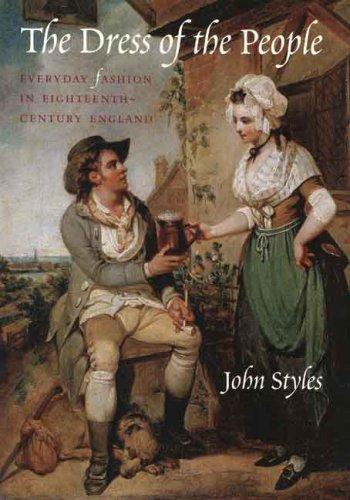
This excellent book by John Styles is just what we wanted to understand more of the social history of the 18th century. In particular, did the people in Milton Abbas have disposable income to buy new clothes? How much social status was attached to the clothes that were worn? How many changes of clothes did they have? What might they have worn to work? To Church?
We are a Local History Group and we undertake research into the old village, the Street and the lives of those that loved and worked there. We appreciate any help that members can provide to that end.
Family historians, please note that we do not focus on Family history’s but if you feel you could help and contribute to the social history of Milton Abbas Please get in touch.