
©Bryan Phillips June 2026
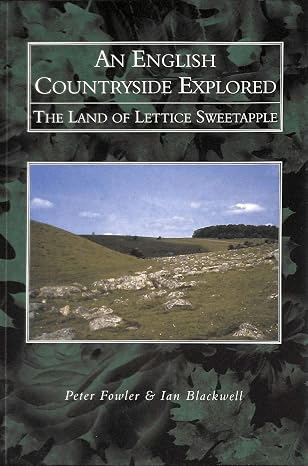
I bought and read this book in 2005, that is before the Milton Abbas Local History Group was formed. I have now reread it with Milton Abbas in mind and the authors’ examination and excavation of two downland parishes Overton and Fyfield, both in Wiltshire, over forty years reveals the similarities of the landscapes of these parishes with Milton Abbas, since the end of the last ice age to today. Remarkably too, King Athelstan granted land to Wilton Abbey, and St Swithun’s Priory, Winchester. The latter having extensive records including Custumals of similar date to Milton Abbey allowing us a great comparison of tenant conditions in the early fourteenth century.
There are very few landscape studies on this scale, although the Shapwick Project, Somerset, by Mick Aston springs to mind, and certainly nothing has been done in Milton Abbas, which is a shame but also an opportunity for the future. The downland excavations reported in this book are some of the very few done in Wessex. Since the research concluded before 2000 there are no LiDAR results. Today these are very revealing and include Milton Abbas and thus presenting us with a splendid opportunity for landscape archaeology.
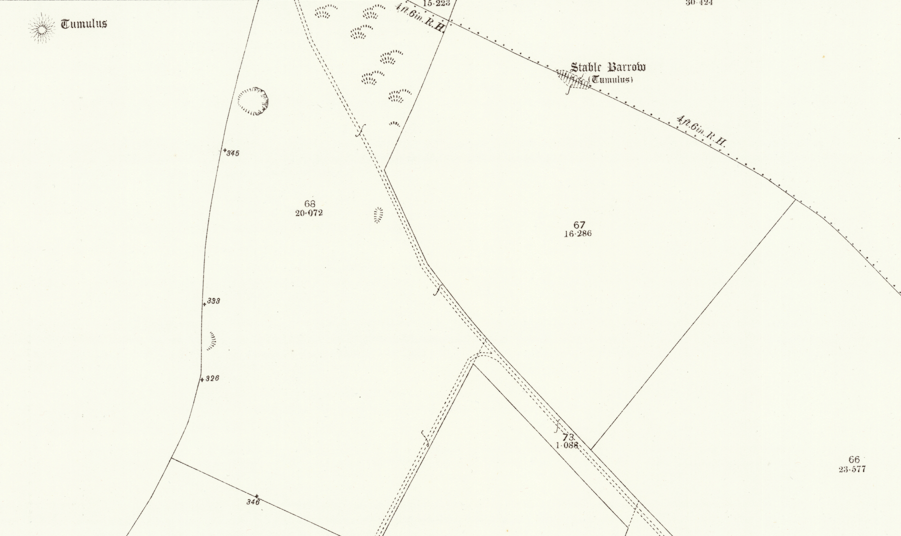
So much can be learned about the uses to which the land has been put, and location of ancient settlements, from using the Ordnance Survey 25 inch maps (which MALHG has), aerial photography and field walking, field and parish boundaries, and woodland. All dependent of the local geology – in Milton Abbas Upper Chalk, clay with flints, and riverine deposits; in Overton and Fyfield Upper Chalk, clay with flints and sarsen stones deposited by retreating glaciers.
The age and location of the various types of barrows also hints at ancient locations of burial and ritual. Below is Stable, or Staple barrow, a neolithic long barrow of 3000-5000 BC sitting on the parish boundary as described in a perambulation of 1384. All these were known, used and named in Anglo-Saxon times. We have, from A D Mills all the names of fields, streets and farms which are mostly Anglo-Saxon names.
 Milton Abbas Local History Group, Dorset, UK