Court Roll of a manor of Milton Abbey

This is a snippet from a court roll for the manor of Sydling St Nicholas which was then held by Milton Abbey. This one is dated 11 Jul in the 8th year of the reign of Richard II which can be read in the top line.

We have a great deal of information about the manors and the tenants of Milton Abbey in the 14th century, but if we could translate some of these court rolls we would have a much fuller picture of what life was like for the tenants and servants of our Benedictine abbey.

Please get in touch if you would like to help us.

Posted in local history, Medieval history, Milton Abbey, social history, transcription | Leave a comment

Protected: AGM 5th Oct 2022, Chairman’s Report and Financial Statement

This content is password-protected. To view it, please enter the password below.

Posted in Uncategorized | Comments Off on Protected: AGM 5th Oct 2022, Chairman’s Report and Financial Statement

Milton Abbas First School 1985 – 1991

Former headmaster Ron Karley has written up the school diary. He has very kindly donated a copy of this 280 A4 page, lavishly colour illustrated tome to the Milton Abbas Local History Group. This has been added to our Records and will be located with our other archives in a secure location. Members of the public can buy copies at cost for £15 from Ron Karley. Use the contact form on this website for enquiries.

If only others would write up their diaries then historians now and in the future would be much better placed to understand past lives.

Thank you Ron!

Posted in books, local, local history, Milton Abbas, social history | Leave a comment

BALH The British Association for Local History

The Milton Abbas Local History Group has been a member of BALH since January 2022. The link to their website together with the member’s discount code has been at the head of all 10 issues of the member Newsletter this year. Group membership runs out 1 Jan 2023. 

It is up to MALHG members to explore the BALH site and get the best out of it. Of particular use and importance for local history research are the publications ‘Local History News’ and ‘The Local Historian’. Previous issues can be searched and downloaded as searchable pdfs. New books are reviewed.

We also recommend the webinars, conferences and blogs. 

The great benefit to our history group is the indemnity insurance which is provided as part of the benefits of membership.

Posted in history, local history, social history | Leave a comment

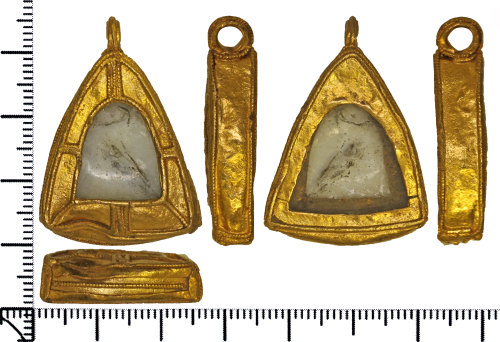
Found in Milton Abbas

This stunning object was found by a metal detectorist somewhere in Milton Abbas. It is of unique design according the the British Museum.

The image is from the Portable Antiquities Scheme where you will find more information.

Posted in Anglo-Saxon, archaeology, Milton Abbas, Old Town of Milton Abbas | 1 Comment

The Reredos of Milton Abbey Church

A dissertation by James Bowler at the University of St Andrews has recently come to our notice which is titled ‘The Life and Afterlife of an English Reredos: A Contextual, Restorative and Aesthetic Analysis of the Great Screen of Milton Abbey, Dorset’.

This shows just how important this reredos is in the history of English church architecture. It is on a par with Winchester, New College Oxford, Southwark, Ottery St Mary and Christchurch, and is one of the finest high walled reredoses in England. All are missing their original niche sculptures although some have been replaced. The date of construction is confirmed stylistically, as the inscription reads 1492, and the design follows that of New College Oxford. This was an expensive undertaking and was probably financed by the then abbot Walter of Middleton.

The author concludes that James Wyatt’s refurbishment was carried out sensitively, leaving the features of the original visible. It would have once looked spectacular with the niches filled with painted and gilded statues, the figures can be deduced from the size of the niches and comparison with other layouts.

We are very much hoping that the other Milton Abbey features such as the pyx shrine, Apostle panels and Abbot’s Hall screen would be subject of more research and recording.

Posted in history, Medieval history, Milton Abbey | Leave a comment

James Jacob  of Waterloo

(1790-1856)  

Research by Clive Barnes

Veteran of Waterloo 
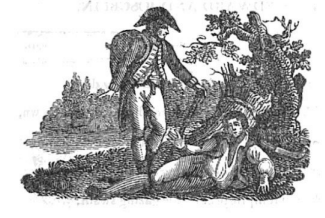
The returning soldier was a common theme in  early 19C literature. This illustration is taken  from an 1803 collection by Whatcombe-born  poet William Holloway.

James Jacob was the third son of  carpenter John Jacob (b 1746). His  father appears to have trained only  James’s elder brother John as a  carpenter; and James was described  as working as a labourer before he  joined the army and as a collarmaker,  harness maker and army pensioner  afterwards.  

James enlisted in the army in 1811,  when he was twenty. The cavalry  regiment he joined, the 7th Light  Dragoons, also known as The Queens  Hussars, was possibly then stationed  near Weymouth. It was a cavalry  regiment which had been fighting with  Wellington in Spain. The continental  war against Napoleon had been raging  for seven years and James may well  have joined up for patriotic reasons. He  may also have felt that he had few  prospects if he stayed at home. The  army offered regular pay and rations.  

The 7th Light Dragoons sailed for Spain  from Portsmouth in 1813. They  endured a long march from north eastern Spain into France and,  crossing the Pyrenees in the winter,  they suffered severe hardship. They  joined battle with the French, first at  Orthes in February 1814 and then at  Toulouse in April.  

They returned to England that summer  and were used in March of the  following year to keep order during the  Corn Law riots in London. Later that  month, the regiment embarked from  Dover for Belgium, and on the 18 June  1815 took a prominent part in the battle  of Waterloo. James was wounded in  the left shoulder, was sent back to  England, and was convalescing in  hospital at Colchester in May 1816.  

He was invalided out of the army in  1817 as an “out-pensioner” of the  Royal Hospital, Chelsea. He received  nine pence a day, paid every quarter in  advance. He joined a large number of  veterans of the armed forces who  returned to their homes after the  Napoleonic wars. In 1828, it is said  there were over 85,000 such men in  the United Kingdom.  

On returning to Milton Abbas, James  married Rachel Vacher in 1819. They  had one child, a daughter, Jenny in  1820. Rachel was described as a  former button maker in the 1851  census and died the following year,  followed by James in 1856. Jenny  married twice. She remained in Milton  Abbas, and was living with her second  husband, Joseph Vacher, at the Lower  Lodge when she died in 1889.  

Posted in Dorset, local history | Leave a comment

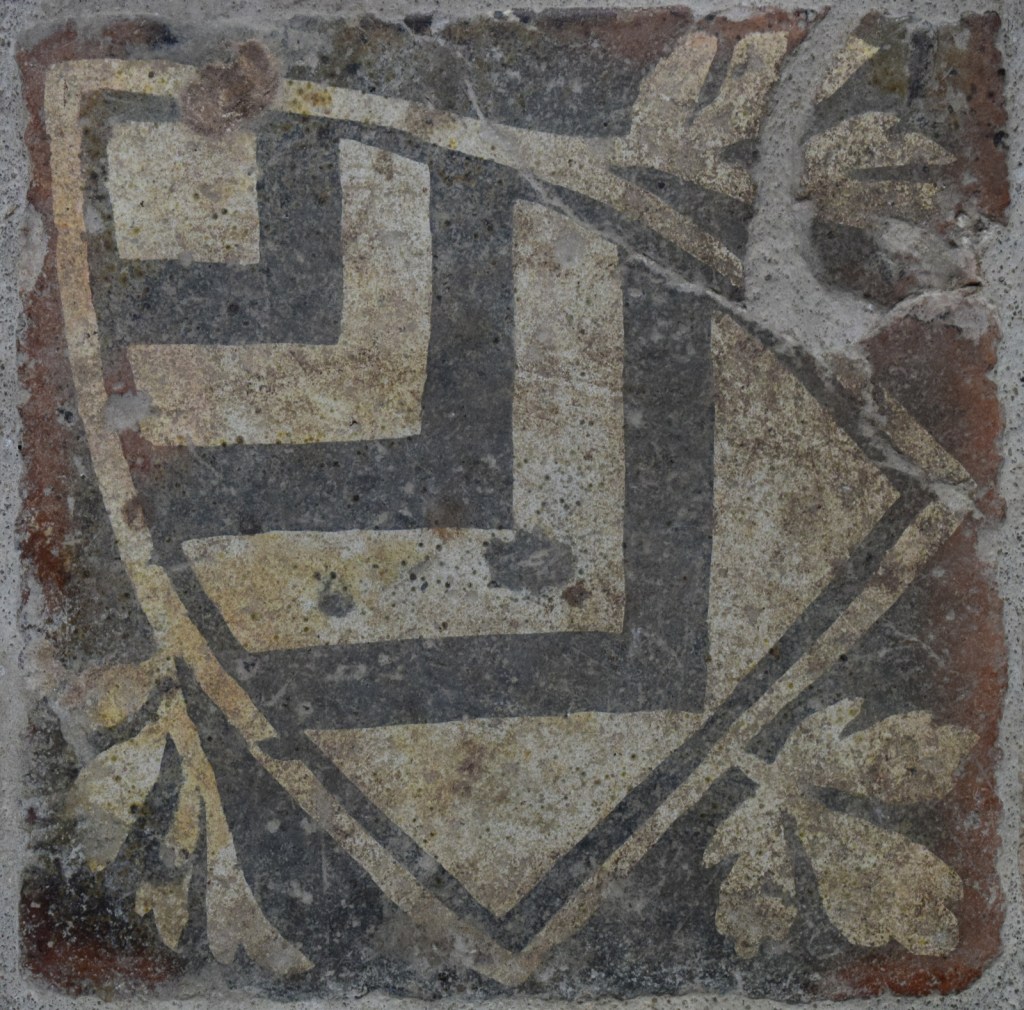
St Catherine’s Chapel – medieval tiles

The Milton Abbas Local History Group have been recording all the medieval tiles in the Chapel. We have photographed them at high resolution.

The tiles were moved from the Abbey Church during its Victorian restoration. They show the results of 600 years of wear and tear, and much of the original glaze has worn off.

Just imagine how many monk’s and pilgrim’s feet have trodden here!

They are well worth a look as some are quite rare.

For more on the importance of St Catherine’s Chapel see our website.

There is good information on the tiles in the book by by A B Emden ‘Medieval Decorated Tiles in Dorset’, Phillimore 1977.

Posted in Dorset, Milton Abbey, St Catherine's Chapel | 1 Comment

Milton Abbas Lake

Our member Clive Barnes gave a presentation summarising his excellent research on the design and building of the dam and lake by Lord Milton to our history group on 1 June. This presentation with maps ‘Lord Milton and the Lake’ is now available for our members on our website. We now know the intentions of Lord Milton and Capability Brown compared to what was achieved when it came to build it. We are still actively researching and mapping the lake, and new LiDAR Digital Terrain Models are helping us understand this.

The court cases which resulted when Lord Milton, his daughter and heir Caroline and her heir Lord Portarlington dammed the Milborne Brook in order to fill the lake were many and may have resulted in the abandonment of Milborne Manor House and the move to Whatcombe of the Pleydell family. We have transcribed and researched these up to about 1820.

But it didn’t end there! A lot more correspondence ensued which is held by the Dorset History Centre – ‘Letters and a few other papers relating to case of Margaretta Michel v. the Earl of Portarlington about obstruction of watercourse, and to some related cases brought by tenants’ D-PLR/L/18.

These letters would be a great opportunity to see English law in action in the early Victorian era and how the ‘great and good'(???) settled their differences. Please get in touch if you would like to contribute to this research.

For more on this dispute and the history of the lake see our previous blog.

Posted in Damer, document, Dorset, landscape, local history, transcription | Leave a comment

St Catherine’s Chapel

New LIDAR Digital Terrain Model data is now available at Archi Maps. This is a revelation for the area around St Catherine’s Chapel. Compare the map on our website showing the entrenchment with the latest DTM

The Chapel itself is the small rectangle in the centre of this image.

Now we can see much more detail and there has clearly been a lot of earth moving. The ground surface has been levelled in places and a bank built surrounding the area with internal banks further dividing the area. Unfortunately without archaeological excavation we will never know when this was done.

However these results do not conflict with the legend of King Athelstan’s army building an encampment prior to a battle. The latest thoughts on the location of Brunanburh show that it was likely at Bromborough in the Wirral, so this encampment would not have been prior to that battle.

Posted in Anglo-Saxon, archaeology, landscape, Milton Abbey, St Catherine's Chapel | Leave a comment