House History

© Anne Brown Dec 2024

At our meeting 4 December 2024 following Bryan Phillips’ presentation on ‘Researching Local History’, many members expressed an interest in studying their house history. Bryan gave an indication of how to start your house history and showed this for Sunny Cottage, Winterborne Stickland. Anne Brown, a member from Sydling St Nicholas has kindly allowed us to share her recent article as an example. Contact us if you wish to start your house history and share it with us.

There is more information on house history on our previous blog.

Webbers

The story of a cottage

There have been Webbers in Sydling almost as long as records go back.  In 1383 Johan “Webbe” rented a cottage from the Lords of the manor (Milton Abbey). In 1440 Thomas Webbe was renting a cottage from for 6s 8d per year. There is a meadow which was called Webber’s throughout the middle ages.

The very first tenant who we know for certain to have lived on the site of the cottage known as Webbers, was Johan (John) Webber, in the 1530s. He held the cottage by copyhold. A copyholder rented the cottage for life, and could nominate 2 lives to take on the rental from them when they died, on payment of a fee.

The Webbers and their descendants lived in the cottage for the next 370 years. 

After John came William Webber, then John Webber, then his sons Thomas and William in 1591 then another Thomas, two Williams, Alice Webber, Dorcas Webber, A couple of Silas Webbers, Sarah, and lastly William Webber in 1769. 

Of course, many Webbers married into other village families. In 1772 the copyhold passed to George Bridle, who had married Elizabeth Webber. The Bridles were here for the next century. They were an old Sydling family too, popping up in records as far back as the 1300s.

The tenants of the cottage also had grazing rights on the common land around the village, and rented plots of land from the lord of the manor, which they were allowed to cultivate or graze.

In 1764 Silas Webber had right of pasture for 1 horse, 13 cows, 1 heifer and 64 sheep, and he rented about 6 acres of arable land, in Churchfield, near Court Ashes and at Cow Lane Bank.

 The rental book below is dated 1831, and shows the fields which George Bridle held with Webbers; the cottage, garden and orchard, 10 acres of pasture in the Combe, 10 acres of arable land in “Little Field”, (at the top of Dry Lane).

The Webbers seem to have been agricultural labourers, and have left little record of their lives apart from births and deaths in the parish records. It is tempting to think that all the major events of the centuries passed them by, as they toiled in the fields and lived their lives in the cottage. But this may be far from the truth. Who knows? 

In 1832, only a year after the rental above was written,15 year old John Webber was buried in Sydling Churchyard. He had been employed by his master, a glazier, to help smugglers to carry away tubs from a vessel, and was shot dead by the coastguards. 

The numbers of inhabitants of the cottage varied enormously over time. In 1841 there seem to be thirteen members of the Bridle family living together, aged from 79 to 4 years of age. By 1851, only two remained. In 1898 Tabitha Bridle had married and moved to Weymouth. When she died in 1908, leaving no-one named to inherit, the copyhold “fell in”. Winchester College took back ownership and rented Webbers to other tenants until they sold it, along with several other properties in the village, in 1956.

The 1956 sales details show that Webbers had mains electricity, but water was from a single tap outside the front of the cottage, and there was an “earth closet”. Life was still primitive!

 Webbers, like many Sydling cottages, was built of banded chalk and flint. It is likely that the stone came either from the ruins of Cerne Abbey, or from the quarry on Giant Hill. The upper storey has chalk cob walls. The date it was built is uncertain. Historic England suggest that the cottage is 17th century, which would mean that it replaced an earlier cottage on the plot. It is thatched, with a catslide roof at one end. The lean-to extension was probably a later addition. Old photos show that this was once much taller.

By the 1970s, after standing for hundreds of years, the old roof timbers of Webbers finally gave way, the roof began to collapse, and had to be shored up by new timbers and supports. The upstairs of the cottage was no longer safe or usable, the stairs were removed, and for the next 40 years, only the ground floor was habitable. The cottage might have been nearing the end of its life.

But luckily, after extensive building works, in 2019 it was repaired and restored, and continues its long life as a family home. Hopefully it will still be standing in another 400 years!

 Anne Brown

Posted in Dorset, family history, history, house history, local, local history | Leave a comment

“Lifestyles of the Rich and Famous” – song, Good Charlotte

© Anne Litchfield Dec 2024

A peek into the life and lifestyle of Jacob Bancks 1704-1738 through his goods and assets as outlined in the inventory attached to probate documents in The National Archives.

When he died in 1738 aged 34 Jacob Bancks, the youngest son of Sir Jacob Bancks and Mary Tregonwell, had assets totalling nearly £2500. In today’s money this equates to a value of between £553,000 (Office of National Statistics) and £956,000 (Dept of English, University of Wyoming), depending on which source is used. In any case I think it is fair to say that he died a wealthy man in goods and chattels if not in coin.

But first a little background history.

When Jacob Bancks, senior, married the widowed Mary Luttrell she was the heir to, and born into “a position of wealth and influence” *. Her first husband was also wealthy and “was to treat his wife to a life of abnormal luxury” * However, the extravagance of their lifestyle (Mary was said to own a fortune in jewels including one piece worth £800 alone) plus the formation and maintenance of two regiments of soldiers to fight in various campaigns, soon brought the Luttrells into debt. On her husband’s death Mary moved into the London town house, closing the country properties, in order to reduce her expenditure, in which it appears she was successful. It was in London that she met Jacob Bancks (later knighted), when he supposedly rescued her from the fire which destroyed her townhouse. Sir Jacob outlived his wife by 21 years (she died following the birth of her second son in 1704) and died in 1724 followed just 3 months later by his eldest son John. This left the estates and fortune in the hands of his second son aged just 21. Jacob’s intestate death in 1738 left us with the inventory we are now examining. 

So – the inventory. I have picked out for the purposes of this blog a few items which I think illustrate my contention in paragraph 2 above, that Jacob Bancks died a wealthy man with a lifestyle to match. The inventory lists 13 bedrooms in the main house, plus 3 in the garret which could have been household servants’ rooms as they also contained items of luggage presumably for storage. In the other 13 bedrooms listed there are 14 beds in total, so plenty of room for guests. I’s also worth noting at this point that other beds can be found in the stables so presumably the grooms slept where they worked! The furnishings of the beds in the main house were of high quality and value. For example the bedding was of worsted (good quality woollen fabric) or camblet (a woven fabric made of goat or camel hair mixed with silk). The garret rooms by contrast had lindsay cloth, a coarse mixture of linen and wool. A couple of the main bedrooms also had tapestry hangings though there is no description of their design and are valued at only £1 or so each. The inventory of household linens lists “11 pair of fine sheets”, “24 pair of servants sheets” and “2 dozen of fine pillowbeers (pillowcases) with an extraordinary value of £38! Turning now to evidence of Jacob’s potential entertainment of guests, whether daytime or overnight, we find a reckoning of his stocks of alcoholic beverages, which would not put a modern publican o shame! At his death Jacob could take his pick from:

2520 gallons of beer (in barrels)
42 gallons of wine (in butts)
216 bottles of port
12 bottles of white wine
36 bottles of claret
18 bottles of sack – a type of fortified wine imported from Spain (sack from French sec or dry)
24 bottles of brandy
168 bottles of rum
12 bottles of arrack – similar to rum made from fermented sugar cane
300 bottles of cider
936 bottles of beer
63 gallons of home-made cider

Quite a party!

We also have a comprehensive list of Jacob’s personal apparel and belongings. These are from his lodgings in Pall Mall, London. “A black paduasoy waistcoat” – paduasoy is a smooth, strong and rich silk from Padua. “A flowered silk banyan” – a type of robe an essential garment for a gentleman of the time and worn indoors, similar to a dressing gown today. “Seventeen ruffled holland shirts” – made from fine bleached linen. “Four India dimity (silk or wool fabric) white waistcoats” amongst many other items totally around £140 in value. He also owned 7 wigs, several pistols, 2 gold watched with chains, cornelian seals set in gold (presumably to mark letters sealed with wax), a picture set with 28 diamonds, a pair of silver spurs, a sliver hilted sword and a gold headed cane. All of which add up to a picture of a gentleman of means and leisure. It seems a shame somehow though that he lived only to the age of 34 to enjoy it all. As the saying goes “shrouds have no pockets”!

Posted in Damer, local history, Milton Abbas, Milton Abbey, Old Town of Milton Abbas, records | 1 Comment

Markets and Fairs

©Bryan Phillips Nov 2024

See our new webpage for yet another mystery in the history of Milton Abbas. There is an explanation of St Sampson’s day fair on this website too.

Milton Abbas fair was the second biggest in Dorset at the time of the Subsidy of 1334, Bere Regis being the largest. People would travel from all over Dorset to meet, trade, find partners and have FUN – much as today. Milton Abbas was the hub of the road network in Dorset until Lord Milton moved the roads in the late 18th century.

The fairs at Milton Abbas were of great importance to the medieval town. They provided income for the abbey because of the tolls for the stalls, they boosted the profits of the tradesmen, especially the inns, they provided games and entertainment for the villagers, and they were where new products could be viewed and purchased.

Many medieval fairs have been revived, although they could not possibly reimagine the smells, the crimes and the liveliness of what took place here before the dissolution. Modern revivals can be visited at Glastonbury, Tewkesbury and Arundel.

The modern biannual Georgian Street Fair at Milton Abbas was a revival begun in 1973 to commemorate the building of the new village you see today.

Posted in local history, Medieval history, Milton Abbas Street Fair, Old Town of Milton Abbas | Leave a comment

Blandford Literary Festival

1831 Riots

©Bryan Phillips Nov 2024

Blandford Museum has been been working with the University of the West of England (UWE) to bring the story of the 1831 Reform Riots to public attention.

One of the riots took place in Blandford over three days in October 1831 as part of the demand for electoral reform and social change.

Part of the collaboration is the creation of a soundscape, an interactive audio experience which tells this powerful story through a self-guided walk visiting key sites where riotous behaviour took place. You can listen to the call for the Riot Act to be read and to the sound of troops on horseback charging at the rioters.

This is accessed by a user-friendly app that can be downloaded to smartphones. The soundscape will be launched at the Blandford Literary Festival. Participants will be able to download the app, with help if needed, or listen to it on a loudspeaker. The walks will last an hour.

for information on the rest of the programme Blandford Literary Festival.

Posted in local history, social history | Leave a comment

Cerne Abbas: its abbey and giant

©Bryan Phillips Oct 2024

We were at the recent conference ‘Cerne Giant and other Wessex Hill Figures’ at the Dorset Museum which discussed the dating of the phallic giant.

There were some interesting talks: one by Barbara Yorke, University of Winchester, showed the real difficulty of establishing the foundation date of Cerne Abbey. No foundation charter exits, only a document by Aethelmaer around 987 which refers to the abbey. At least we know the date of the foundation of Milton Abbey as there was a foundation charter of Easter 934 by King Athelstan, although the original is now lost, it was copied into both Latin and Old English. The medieval records of Cerne Abbey manor are very patchy and the earliest appears to be 1343 so its history is not as well known as Milton Abbey’s. See Peter Traskey’s superb book ‘Milton Abbey: A Dorset Monastery in the Middle Ages’ Compton 1978.

Although the recent dating of the Cerne Giant hill figure by optical stimulated luminescence is reported by archaeologists as secure, Ronald Hutton showed that the new date raises even more questions than the previously believed dates. Also the word element ‘giant’ or the Old English ‘ent’ does not occur in any Dorset place name, although there are a couple of ‘Grim’ and many ‘burg’ for barrow. This is despite the fact that many place names are indicative of local landmarks. Perhaps the Cerne Giant was not visible for very long after it was made? Chalk hill figures require scouring and re-chalking every ten years or so, otherwise they become overgrown and invisible. The grass steps at Milton Abbas have similarly suffered in recent decades.

It is noted that the the giant on the hillside was used and thought of as a fertility symbol in local folklore. Interestingly its location in the landscape being on a scarp slope nearby and facing Cerne Abbey has many similarities to that of St Catherine’s Chapel at Milton Abbey which also gave rise to a  fertility cult in folklore. See our webpage.One of our members has examined the LiDAR images but no hint of a ‘hill figure’ can be seen in Milton Abbas.

Note that in the Exon Domesday Book the land holdings at Cerne and Milton at around 120 hides were very similar in total and at the home abbey.

Posted in Anglo-Saxon, archaeology, Dorset, Milton Abbey, St Catherine's Chapel | Leave a comment

Winchester College Archives – new findings

©Bryan Phillips Oct 2024

A huge thank you to Winchester College and their archivist, Suzanne Foster, for helping the Milton Abbas Local History Group with its medieval research. There are early manorial documents concerning many of Milton Abbey’s manors. These manors seem to be quite stable from the foundation charter of King Athelstan Easter 943 through Domesday Books 1086 until its Dissolution in 1539 quite unlike many other monasteries who were buying, selling, leasing and being given land.

The Winchester College archive is also comprehensively catalogued and it is easy to find the relevant documents.

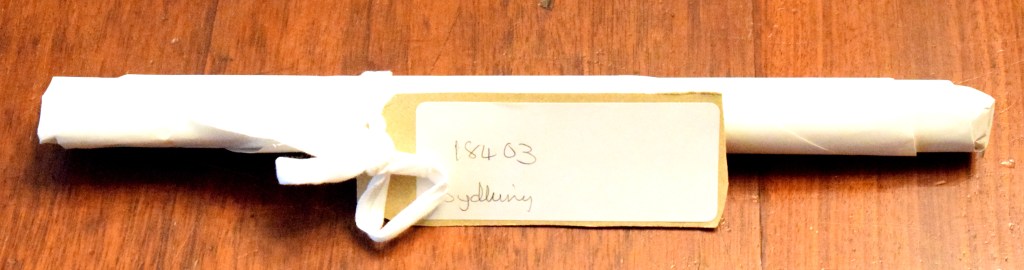
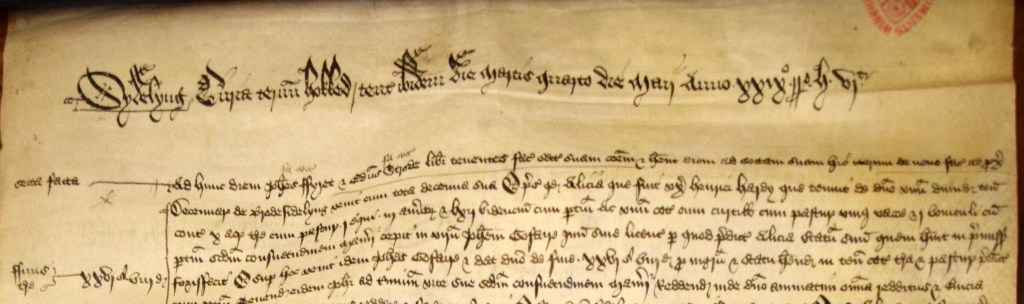
and it is so exciting to look inside these rolls to see the treasures they contain:

We are finding new information in these archives, for example, there is a fine original of the Customary of the Manor of Sydling St Nicholas 1322 (WCM 18382) which fills in some gaps in the Custumal of Milton Abbey which has been mutilated over the seven centuries since its first writing. One of our members is currently translating this from the Latin. These wonderful documents tell us so much about the lives of the ordinary people living on a monastic manor. Of course, finding new information inevitably leads to more questions to answer!

You can find more information on the medieval Milton Abbey manors on our webpage.

Do please get in touch if you are interested or would like to help us unravel the meanings hidden in these records.

Posted in document, history, local history, Medieval history, Milton Abbey | Leave a comment

WW1 Research

©Bryan Phillips Oct 2024

Pamela Phillips has been busy downloading newspaper articles for the period 1911 to 1920 concerning Milton Abbas people before, during and after WW1. Around 150 new articles have been transcribed and added to our Records. These articles are a name rich source and many familiar names are included in this research – HAMBRO, SPILLER, JESTY, VACHER, DR DOMINY, LOVELL, CHURCHILL, PENTIN, FOOKES, etc. Interesting topics include the farmer’s club meetings, the Slate Club, egg collection for the war effort, cricket matches, Hambro dinner parties for all, jobs wanted, situations vacant,  dogs lost etc giving a view of the goings on in a rural agricultural village.

These articles can now be searched for names and events, which will be the task of the WW1 research group. All this research is part of their work towards a book which will be published in due course. If you have information or relatives from Milton Abbas during this period please get in touch.

Posted in Hambro, local history, Milton Abbas, WWI | Leave a comment

DORSET FAMILY HISTORY SOCIETY OPEN WEEKEND

©Bryan Phillips Sep 2024

On Saturday 5th October and Sunday 6th October 2024, 10am – 3pm both days, our Treetops Research Centre will be open for anyone to call in, meet our volunteers, see what we have to offer and find out how we can help with your family history research.

All are welcome; experienced family history researchers, those just thinking of starting their family tree,  and those who have started but need some helpful advice to continue their research.

The Centre has access to all the major Family History websites, Parish Register transcriptions for Dorset and miscellaneous information from other counties, Monumental Inscriptions, an extensive library and a Sales area. Experienced volunteers are available to give one to one help and guidance, not only to those with Dorset ancestors but from wherever your ancestors came from – worldwide.

Both members of the society and non-members are welcome – no booking necessary.

Posted in family history | Leave a comment

New Season – we’re ready!

©Bryan Phillips Sep 2024

The Milton Abbas Local History Group is about to embark on its new season of talks and research.

The talks will be focused on the history of Milton Abbas and they will mostly be given by members of the group who have been busy researching. The next talk on Wed 2 October 19:30  in the Reading Rooms will be on the Milton Abbas men who served at Waterloo. Also this season there will be talks on the New Town Houses, Researching Local History, the Churchwardens of Milton Abbas, and the Move of the Old Town to the New Village.

New documents are being found all the time and we now have a catalogue of over 5300 which can be searched by our members.

Our website is still expanding and now has 200 blog posts as well as 110 pages of detailed historical facts about this amazing place. You can use the search box on every page of the website to find information which you are interested in. Any suggestions are always welcome, of course. Please come along to our meetings or contact us on our website Contact page and tell us of your interests.

The history group also has a Research Group who meet four times a year to discuss their progress. Some of the topics being actively researched are the people and community of Milton Abbas just before, during and after WW1, histories and occupations of important Milton Abbas families, the lives of the people of Milton Abbey’s manors in the fourteenth century, the building and contents of the manor house from the Dissolution to the present, the life and letters of Caroline Damer, 

If you have other topics which pique your interest please come along and meet us.

Next meeting in the Reading Rooms is Wednesday 2 October, 19:30. We look forward to meeting you.

Posted in document, Dorset, history, local history, Medieval history, Milton Abbas | Leave a comment

More Mysteries – can you help?

©Bryan Phillips Sep 2024

There are still plenty of mysteries to solve in the history of Milton Abbas, click on the drop-down list on our web page.

One of our new members, Derek Robinson, has sent us an intriguing picture of the Milton Abbas District. 

We have definitely not seen it before and we don’t as yet know what the Milton Abbas District was. We have not seen the banner before, nor any references to it. Whatever group it was, it is unusual in having both men and women. 

It should be possible to date the photograph quite accurately. Our current estimate is c1912. Note some of the men are wearing society badges (not medals). We love the very smart outfits and the hairdos.

We don’t recognise any of the people either.

Could this be a Methodist District? Ancient Order of Foresters? Friendly Society?

If you can help please contact us here.

Posted in Dorset, family history, local history, Milton Abbas | Leave a comment