

Milton Abbas was granted two annual fairs held over two or three days, and two weekly markets:
| Market | Thursdays; granted 27 Dec 1252, by King Henry III to Abbot and Convent of Middleton |
| Market | Mondays; granted 29 May 1280, by King Edward I to Abbot and Convent of Middleton |
| Fair | Assumption of Mary (15 Aug); granted 27 Dec 1252, by King Henry III to Abbot and Convent of Middleton. |
| Fair | The feast day and following two days of St Sampson (28 Jul); granted 29 May 1280, by King Edward I to Abbot and Convent of Middleton . To be held at the manor. This relates to our Street Fair which was resurrected in 1973. |
It is probable that the weekly markets were held in the market square and ‘Market Street’ in the old town before Lord Milton destroyed that town.
But where were the fairs held?
They would have been too large an event to take place in the old town itself. People from all over Dorset would have travelled to Milton Abbas before the Dissolution of the monastery. They would have traded livestock and every other consumable of the period as well as entertain the visitors.
In some towns they would be near a cross roads and at others on a nearby hill. Metal detecting can help locate these places. Frequent occurrence of small change, such as cut half-pennies, and cut quarter-pennies are found on former medieval market sites. One field that has been searched has produced many metal objects used for cooking pot repairs, lead work and horse fittings but rather few coins. It seems unlikely that it was the location of the fairs.
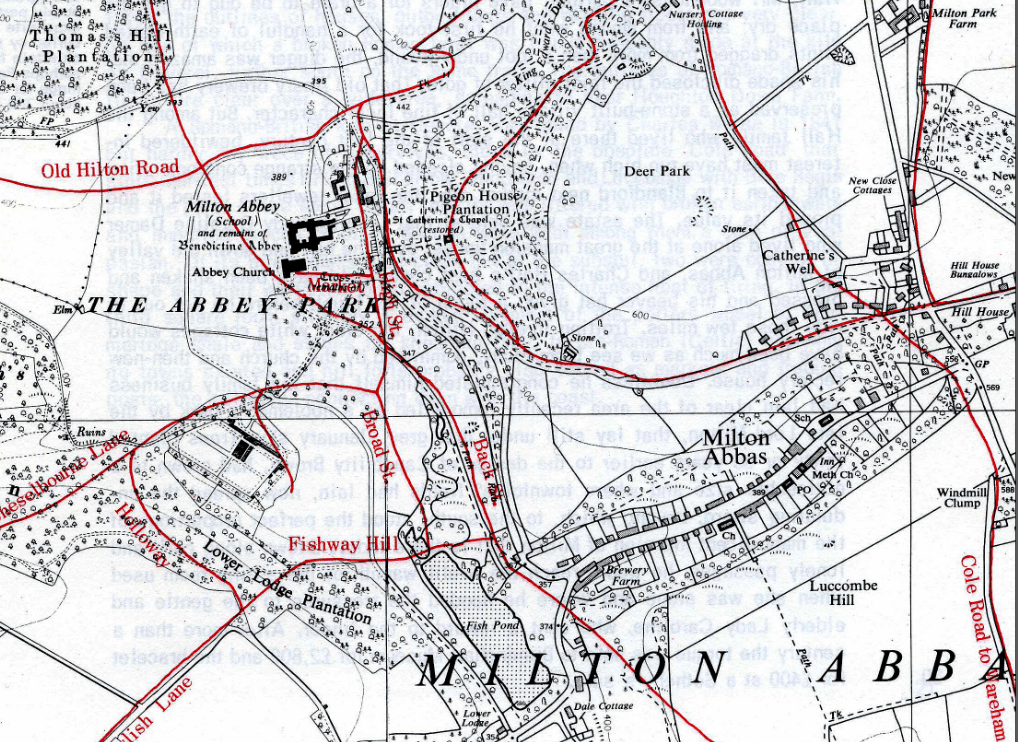
part of map from A Tale of Milton Abbas, Richeldis Wansbrough showing possible locations of the old roads which may have been used in medieval times.
One location that is recorded was given as Windmill Ashes which is at the centre right of this map. This is on one major route into the town which was used to bring charcoal to Milton Abbas, hence Cole Road, from the port of Wareham, and it is on a hill top.
Woodbury Fair is an example of a hilltop fair.
But could it have been the location of the fair? Only archaeology or metal detecting can tell us.
Charles Bullock, metal detectorist, says: “From experience of several fair sites I have detected on there is usually a wealth of material with much coinage and small artefacts. Much of the coinage would be cut quarters and half pennies, these are very hard to locate when dropped and it is a good indication of trading. Also seal matrices and rings are quite often found. Gold coinage does feature now and again. The fair site at Wareham was very prolific with finds even after a club had detected the site for some years. It is now a housing estate. Interestingly all the fairs that I have detected on are at cross roads outside of the village. Also water features highly too and at Bowerswain , Gussage All Saints they wintered the horses in the low-lying areas. A study on the horseshoes revealed most of the nails were of the winter type, with protruding nails, so perhaps a winter horse fair.”
Please contact us if you have information on medieval market locations.
 Milton Abbas Local History Group, Dorset, UK