Who built the new village of Milton Abbas?

It is not certain who was responsible for the design and building of the new “model” village of Milton Abbas. The names that have vied for credit are Sir William Chambers, one of Lord Milton’s architects, and Lancelot “Capability” Brown, the designer of Lord Milton’s park. Thanks to our recent research into Lord Milton’s account at Hoare’s Bank, it is now possible to add another two names to that list, that of William Bragg, Milton Abbas carpenter, and George Lillington, Milton Abbas mason. Clive Barnes explains in our latest blog.

Still in business today, C. Hoare & Co. describes itself as “the United Kingdom’s oldest privately owned bank”. Joseph Damer had an account there from 1768 until his death in 1798; and its record survives in the bank’s archive at its headquarters in Fleet Street.

As a historical source, bank accounts are not very revealing, just lists of names and sums of money, with rarely an indication of what the payments or receipts are for. When I visited the bank archives, I hoped that I might find some record of Damer’s payments for the leases that he bought from his tenants before clearing the Old Town, but there were no names of leaseholders that I knew. However, I did find a cluster of relatively substantial payments to two names that I recognised, mason George Lillington and carpenter William Bragg.

Most of these payments took place between late 1778 and early 1781, sometimes to the men separately, sometimes together, and usually in round sums of £100 or £200. Altogether the two men were paid nearly £1,500 in 12 payments between December 1778 and February 1782. An equivalent sum today would be well over a hundred times that amount. The payments suggest that Bragg and Lillington were being paid as leaders of work gangs rather than for their individual work. This is the period in which other sources place the building of the new village, so it is a fair assumption that it was Bragg and Lillington who were in charge of the building work.

This discovery adds a new dimension to the question of who was responsible for how the village looks today. Both William Chambers and Capability Brown submitted plans for the village: Chambers in 1773i and Brown a year laterii, after Chambers had resigned as Damer’s architect. Neither of these plans have survived but the plan of the houses and the shape of the street and its location seem to suggest that the vision of both men may have played a part in the final shape of the village and its houses. But the village’s most striking aspect, the traditional cob and thatch construction of the buildings, is typical of neither Chambers or Brown. Of the two men, Brown is thought to have been more likely, since he sometimes retained an example of older vernacular architecture within his parks. However, if cob and thatch was his idea, it seems it was left to two local men to carry out the work.

William Bragg was the fourth generation of a family of carpenters and wheelwrights working in villages around Milton Abbas. He served on the Milton Abbas parish vestry as churchwarden and overseer, as his father John had before him. George Lillington was the son of another George, also a mason in the Old Town. Both men brought generations of skill and experience to the task of building the new village. At this time, it appears to have been usual for carpenters and masons, who also counted bricklaying among their skills, to work together in this way on the erection and repair of traditional buildings, supported by other craftsmen like glaziers and thatchers and a team of labourers. Generally, there would be no need for supervision from master builders or architects, although in the case of the new village there was clearly some direction to the men’s work.

The memory of the role of these men in the building of the houses lived on in the village for a hundred years or more. Relying on what he was told by local families, Herbert Pentin, the antiquarian vicar of Milton Abbas, and a chronicler of village history, recorded in 1904 that “when Lord Milton built the “new town” of Milton he intended the houses to be of brick and tile, but he allowed Mr. W. Lillington to build the first two, on the north side, of cobb and thatch, which so pleased his Lordship that the whole of the houses were built of the same material.  The builder was paid £100 a house, with permission to use what materials he could get from the demolished buildings of the old town.” iii

The detail of this does not exactly match the evidence in Hoare’s bank account but the assertion that Damer engaged local men directly to build the village is entirely supported by the payments in the account; while the question of why Damer decided to have it built in this way remains open.

It may have been his choice simply because it was cheap. Most of the material for the walls and roof, mainly earth and straw, were to hand, only sand had to be imported; lime for the render was in constant production on the estate, which may also have been able to produce bricks for the chimney stacks. There was timber growing on the estate, but typically carpenters would re-use sound salvaged timbers if these were available, and, as suggested by Pentin’s account, there was a wealth of reusable demolition material from the Old Town site.

While the cottages were no doubt meant to enhance Damer’s reputation as an estate improver, the people who lived there were, after all, only craftsmen and labourers, and the traditional style of the cottages suited their lowly status. Damer gave Bragg and Lillington leases in the new village and they lived and worked in the village they had built until their deaths, William in 1792 and George in 1809.

It was Joseph Damer’s money and ambition that made the village possible, and it was almost certainly both Chambers and Brown who had a hand in shaping it. Now the entries in Hoare’s bank account provide convincing evidence of the role of the villagers themselves. It was the traditional skills of Bragg and Lillington and their fellow workers, now largely forgotten men, that contributed so much to the picturesque quality of the village and which have excited the admiration of visitors for over two hundred years.

i Letter from Chambers to Milton April 3 1773 quoted in Arthur Oswald, Market Town to Model Village, Country Life September 29 1966, p. 764

ii Lancelot Brown Account Book, Royal Horticultural Society, Lord Milton’s Account, p 25

iii Handwritten notes on an article in Milton Abbas Parish Magazine May 1904, supplied as a photocopy to the Milton Abbas Local History Group by Peter Traskey and transcribed by Pamela Phillips. Record 1284 in the History Group database.

Posted in local history, Milton Abbas, Old Town of Milton Abbas | Leave a comment

Women

It has to be admitted that women in England have had a very poor deal since the time of William the Conqueror. It is only in the late twentieth century that they have regained the rights they had in Anglo-Saxon times. That is 900 years of oppression.

It seems outrageous to us today that by law all women’s property and estate automatically became that of her husband’s when she married. This law persisted up until 1882. It is equally outrageous that universal women’s suffrage did not become law until 1928. I am ashamed that Britain was one of the last countries in Europe to grant women full voting rights with the Equal Franchise Act.

We know that from the 15th century women competently ran large estates, and defended them. The letters of Margeret Paston of Norfolk to her husband, who was in London for many years, testify to this.

Looking at the wills of local people of the 17th and 18th century it is clear that the men who left wills (and it was mostly men, occasionally widows) referred to their ‘much beloved wives’, these men bear witness in their wording and bequests which shows how much they appreciated their wives. The men loved their wives and children every bit as much as today.

Many widows continued to run the family business after their husband’s decease, especially, but by no means exclusively, inns and brewing. They could also take over the farms and manage them successfully.

In the 18th and 19th centuries almost every male in the country, from the Archbishop of Canterbury to the local Overseers of the poor, believed that women should be married. Single women were stigmatised socially and economically. Women were paid generally only half the man’s wage for an equivalent job and employers before the industrial revolution preferred married women over single women.

In Dorset by-work for women such as spinning, button, lace and glove making had their boom and bust times. They each went bust with the introduction of machinery. Even in the boom times women could earn only between 6d and 1s 6d per day – and that was a dawn to dusk job, six days a week. This could supplement the family’s income, but with weekly rents at around 2s, and food and clothing to find, this left very little over.

Single women could not afford accommodation unless it was really bad. Of course, for single women and widows in rural areas, they had the parish to fall back on. The Overseers of the Poor had to raise and collect ‘Poor Rates’ to distribute to the needy. Most of the occurrences of payments to the poor which we have studied concern payments to single women, widows and those too infirm to work.

The Overseers were under great pressure from the rate payers to reduce their payments, with the result that they worked hard to get children apprenticed from the age of seven, families forcibly removed to other parishes and young women into service.

Posted in social history | Leave a comment

Pleydell v Earl of Dorchester 1795

This document is a note book of 60 hand written pages by one hand. It is held by Dorset History Centre, catalogue reference D-PLR/L/15. It contains transcripts of letters, opinions and memoranda of proceedings in the case of Pleydell v Earl of Dorchester concerning the latter’s damming of the Milborne Brook to fill his lake. The documents are from1 Aug 1795 to 24 May 1798. Note that the 1st Earl of Dorchester, Joseph Damer, died on 12 Feb 1798.

The status of the two parties is clear, the Earl of Dorchester (both 1st and 2nd) address Edward Moreton Pleydell as ‘Pleydell’, or ‘Dear Pleydell’, whereas EMP addresses them as ‘My Lord’.

The document gives an insight into the mindset of Joseph Damer ‘this unmannerly, imperious lord’, (according to his architect, Sir William Chambers). Although an old man at this time, about 77 years of age at the beginning of this case, it is clear that he had lost none of his irascibility, refusal to compromise, nor manipulation of his privileges in the House of Lords and Court of King’s Bench to get his own way.

Note that the lake filling was not attempted until 1795, which was 12 years after the death of Capability Brown. It has been stated elsewhere that Capability Brown’s foreman was responsible for designing the lake. On the map related to this dispute a three arched bridge, typical of Capability Brown’s designs, was still in existence, and it is possible that this remains today under the dam or embankment made in 1795.

Certainly the damming of the watercourse caused great hardship and difficulty downstream at Milborne St Andrew, which was, at this time, in the ownership of Edmund Morton Pleydell who brought the action against Damer. With insufficient water at Milborne, the mill was inoperative, the meadows could not be watered and cattle could not be kept on his farm. Pleydell complained that the house could not be inhabited, and that he had to move to another of his properties, at Whatcombe.

After Joseph Damer died, the action continued with his son George, now the 2nd Earl of Dorchester, apparently in a more gentlemanly way, although this Lord took some time to agree to pay £1000 compensation, despite the judgement against his father for £3000. Whereas Joseph was living at Milton before his death, George was living in London. In the end, Caroline Damer paid the £1000 plus legal costs for the two cases, although it would be good to have this confirmed from the Damer bank accounts.

We also need to confirm that the water was restored, and exactly when.

Posted in Damer | 2 Comments

Bills and Receipts of the Overseers of the Poor of Milton Abbas 1787- 1823

In the Dorset History Centre there are some 140 pieces of paper catalogued at PE-MIL/OV/2. These are the bills and receipts of our Overseers of the Poor. We are in the process of transcribing them. They provide further information to the entries in the Overseers of the Poor Account Books, which we have already transcribed.

Just one example: 

It reads 

“May 5th 1787 Recev’d of Mr Ja’s Gregery & B Vacher Overseears of Abby Milton the Some of Seven pounds being the full Consideration from the Said Parish of Milton Abbas for Will’m Seagar bound out to Tho’s Pike of the Parish of Pimphorn Carpenter   T Pike”

So the Overseers of Milton Abbas sent William Seagar, a poor boy of Milton Abbas, to be an apprentice to Thomas Pike of Pimperne, Dorset, a carpenter. The Milton Abbas Overseers paid £7 to Thomas Pike to be an apprentice.

This William Seagar was born in Milton Abbas and baptised on 18 Mar 1772, hence he was aged 15 at the beginning of his apprenticeship.

His brother Richard was also sent as an apprentice to the same master on 9 Nov 1791, aged 16.

It was common in the 18th and 19th centuries to get the poor children of the parish apprenticed to a trade, and pay the master. Sometimes the Overseers provided the child with clothing too. Some parishes apprenticed their poor children as young as seven. The term of apprenticeship was seven years.

There is plenty to tell of the Seager, or Seagar family of Milton Abbas in the 18th century. Ann Seagar regularly received poor relief from the Overseers, and she had several illnesses. Here is an example from 20 Jul 1777

This says “Gave Elizabeth veacher for giting Kowis uern for ann Seager 6d”. Or, in modern English: “Gave Elizabeth Vacher for getting cow’s urine for Ann Seagar”. This is not the only mention of cow’s urine being used as a medical treatment in our Overseers of the Poor Books, although it does not occur in 18th century medical text’s, so must have been a folk remedy.

Cow’s urine is still considered useful in today’s medicines. This is from a 2017 review article: “Many researches have also be done, which shows its use for treatment of Skin diseases, Stomach diseases, kidney diseases, Heart diseases, Stones, Diabetes, Liver problem, Jaundice, Athletes feet, cyst, Hemorrhoid etc. and show its Immunostimulant, Bioenhencer, Anticonvulsant, Anticancerous, Wound healing, Antioxidant and Antimicrobial properties.”

Cow’s urine has been used recently for coronavirus, admittedly only by Hindu’s in India.

Posted in local history, Milton Abbas, social history | 1 Comment

Milton Abbas shoemaker

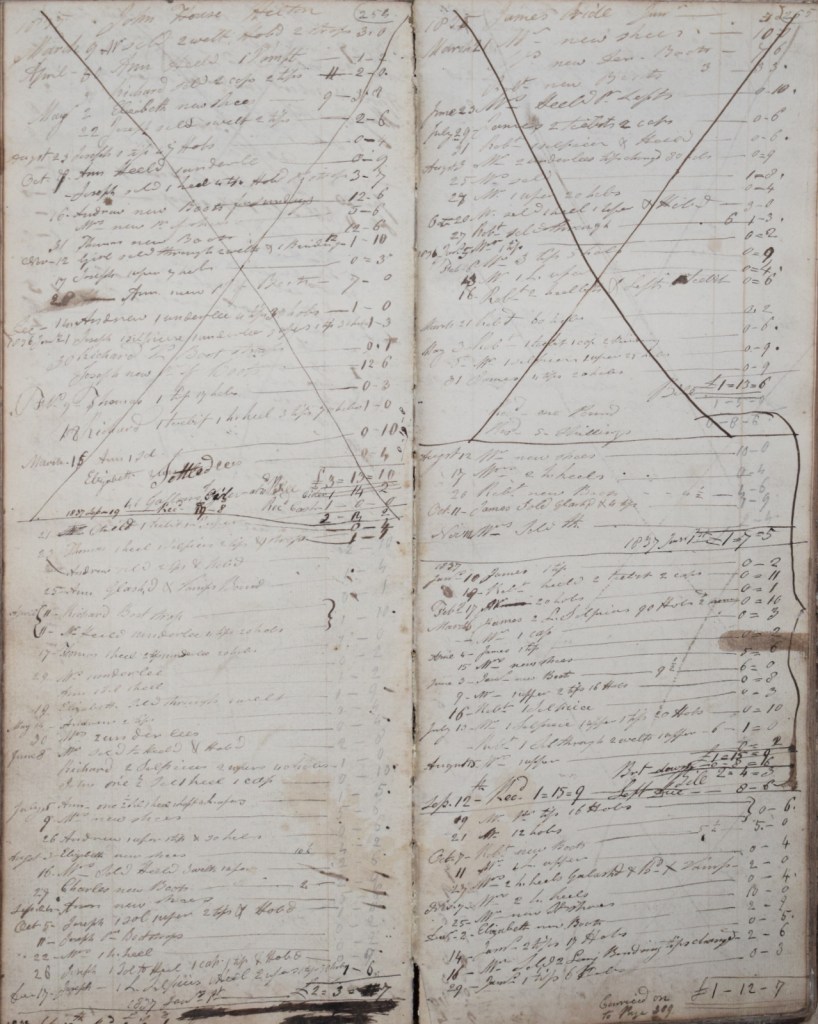
We have the account book of Joseph Rogers 1830 – 1839. It gives a unique glimpse into the life of a shoe maker in a rural Dorset village.

The handwriting of Joseph Rogers, is small and cramped and this was his rough accounts listing his customers, the boots, shoes and repairs and how much he charged. The summarised accounts were probably then entered into a neat book, and he then crossed through his entries in the rough book.

If anyone is researching village shoe repairers, boot makers, or the Rogers family, they may be interested in this account book. Please get in touch.

Posted in Milton Abbas, social history, transcription | Leave a comment

the most tedious document…

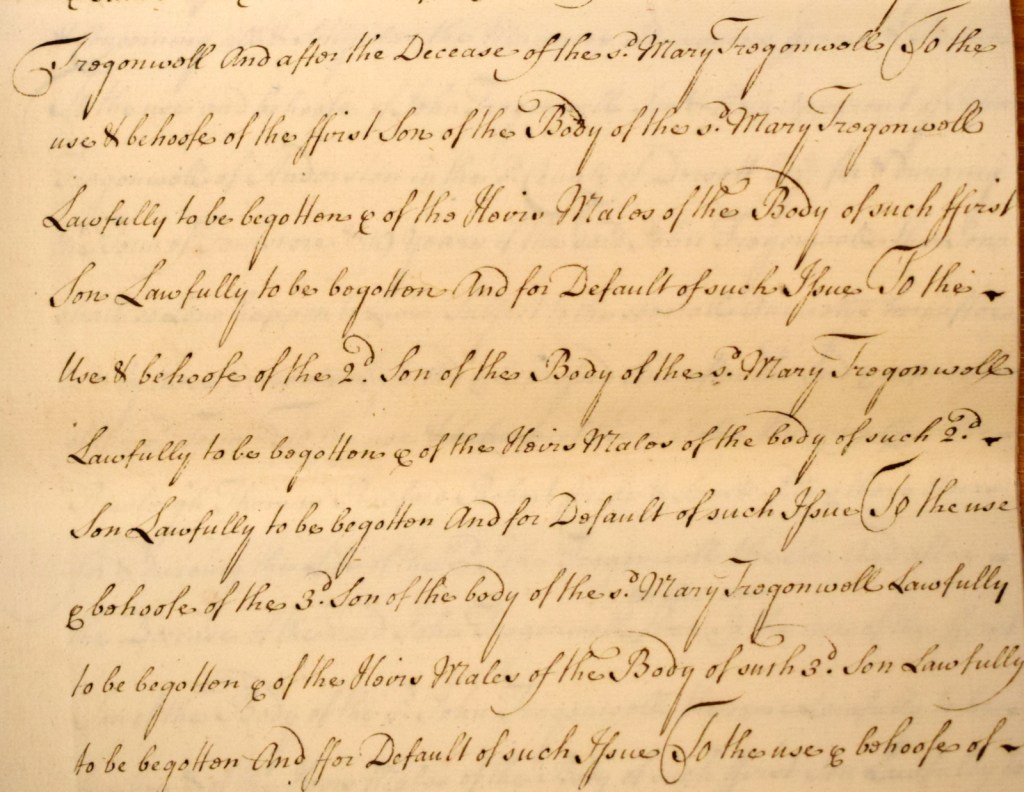
Amongst the hundreds of documents that we have transcribed this is surely the pinnacle of tedium – an Indenture between John Tregonwell and John Harding, Charles Rawleigh, Thomas Radford, Robert Freke, 1678.

Here is a sample:

………if she the s[ai]d Katherine Tregonwell shall so Long happen to Live Subject to the seve[ra]ll Annuetys hereafter Lymitted & Expressed And after the end & Expiration of the said Terme To the use of the s[ai]d John Hurding Cha[rle]s Rawleigh Tho[ma]s Radford Robert Freke & Sam[ue]l Pitt & their Heirs for & dureing the Life of the s[ai]d Katherine Tregonwell and after the Decease of the s[ai]d Katherine Tregonwell then To the use of the First Son of the Body of the s[ai]d Katherine Tregonwell Lawfully to be begotten & of the Heirs Males of the Body of such First Son Lawfully to be begotten And for Default of such Issue To the use & behoofe of the 2nd Son of the body of the said Katherine Tregonwell Lawfully to be begotten & of the Heirs Males of the Body of such Second Son Lawfully to be begotten & for Default of such Issue To the use & behoofe of the 3rd Son of the Body of the s[ai]d Katherine Tregonwell lawfully to be begotten & of the Heirs Males of the Body of such third Son Lawfully to be begotten And for Default of such To the use & behoofe of the 4th. 5th. 6th & all & every Son & Sons of the body of the said Katherine Tregonwell Lawfully to be begotten Successively one after another to each of them & the Heirs Males of their respective Bodies to be begotten the one and his Heirs Males of his s[ai]d Body to take before the other & his Heirs Males of his Body According to Priority of Age & Seniority (of – crossed out) in Birth of every such Son & Sons respectively And for Default of such Issue then To the use & behoofe of the Dau[ghte]r & Dau[ghte]rs of the body of the said Katherine Tregonwell to be begotten and of the (and of the –crossed out) Heirs of the Body of such Dau[ghte]r & Dau[ghte]rs Lawfully to be begotten The said seve[ra]ll Remainders to the said severall Son & Sons of the s[ai]d Katherine Tregonwell & the Heirs of the Body of such Son & Sons and for Default of such Issue to the Dau[ghte]r & Dau[ghte]rs of the body of the s[ai]d Katherine Tregonwell & the Heirs of theirs Body to be Subject to the seve[ra]ll yearly Rents & Sums hereafter Limited And Of & for Concerning the other Undivided Moiety………

There are many pages just like this.

Many thanks to our transcriber, Shirley Chick, who has the patience, concentration and fortitude to tackle such a tedious document.

Posted in document, transcription | 1 Comment

Telling Stories of the Old Town of Middleton

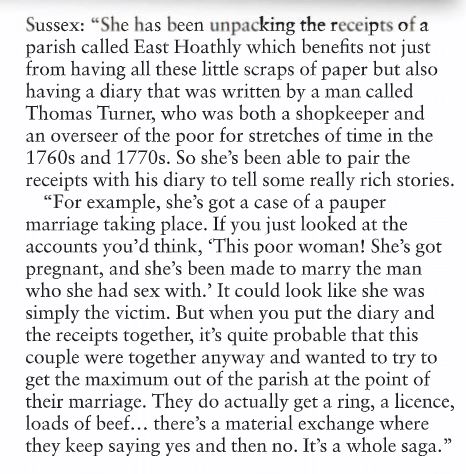
We came across this piece in the Summer 2020 issue of the magazine ‘Who do you think you are?’. It is on page 46, in an article titled ‘The Lasting Value of Vouchers’. This magazine is free to read for members of Dorset County Libraries.

M

Milton Abbas Local History Group, does not have the actual vouchers, but all the entries that were once on the vouchers appear in the Overseers of the Poor Account Books and give the same information. All the account books which exist for Milton Abbas have been transcribed, and available to our members for research.

We also have in our library the ‘Diary of Thomas Turner’, who was a shopkeeper and Overseer of the Poor, and gives a great insight into rural village life. Especially interesting are the problems of being an Overseer – finding the local Justice of the Peace at home, attending the Petty Sessions, getting people in front of the justice, removing paupers to another parish, and so on. All unpaid and taking many days work a year.

Diary of Thomas Turner, 1754 - 1765, Vaisey

Posted in local history, Old Town of Milton Abbas, social history | Leave a comment

Transcribing

This is a recent example of the kind of transcription that takes so many hours of painstaking work.

It is a tiny part of the will of Richard Squybbe 1591.

At least it is in English! Some wills of this date are in Latin – and one of our transcribers is now working on one of those.

A huge thank you to all our transcribers, who have made such an enormous contribution to our understanding of Milton Abbas history and to our heritage. Future researchers owe them a great debt.

Not all our documents are as difficult as this – please get in touch if you would like to help.

Posted in Milton Abbas, transcription | Leave a comment

Milton Abbas house history

For those exploring their house histories we have just transcribed the 1920 Electoral Register, and are transcribing all of the available Registers. We have saved the electoral rolls using the Dorset Library free access to Ancestry. There seems to be a large increase in the number of voters in Milton Abbas between 1877 and 1890, probably because eligibility to vote changed.

We have completed the transcription of the 1911 Census, and the 1939 Register. These are the most useful to begin with because they give the house numbers, which are not available in earlier documents, although they can be worked out from earlier censuses with care. 

We already have all Kelly’s Directories of Milton Abbas transcribed, and the censuses of 1841, 1851, 1861, 1871, 1891, and 1901 are all available at opcdorset.org. 

Thus members can now easily search these records to build up a picture of who lived in their house over time..

Posted in local history, records, social history, transcription | 2 Comments

A House Through Time, BBC2

We have been watching David Olusoga’s third series on ‘A House Through Time’ broadcast on BBC2

This is a fascinating programme showing how good research can bring to life ordinary people and how they faced tragedies in a particular household. These programmes would be a great way to teach children history, and make it relevant to them. The major historic and political events such as Spanish flu, WW1, Suffrage, etc are introduced as incidental to people’s life stories, but always in relation to their family life.

I hope you are all watching this series and that you have been encouraged to do your own house history, and see how former tenants and owners coped with everything that life threw at them. I think these stories help us cope with our own lives by putting in context what our forebears had to deal with. In particular, for the cottages in Milton Abbas street built around 1780, it is possible to determine how many people were living in one address, how badly they were overcrowded, what their occupations or trades were, their baptisms, marriages and deaths, their poverty, and so on. 

It is clear, for example, from a brief look at the Censuses, that for women in Milton Abbas, there was a dramatic change in circumstances from the growth and collapse of the Dorset Button industry and then the growth and collapse of the glove making industry. Both cottage industries were destroyed by mechanisation. The overcrowding and living conditions in the street were reported as a disgrace in the national press. Most of the men were agricultural labourers working for the estate, and their working conditions, life expectancy, and medical complaints show what life was like.

We have transcribed plenty of records such as Kelly’s Directories, Overseers of the Poor, wills, settlement examinations, etc which can be used to find out more of the history of the house where you live.

Posted in local history, Milton Abbas, social history | 1 Comment